
Separate what an assistant answers, what an authorized person decides, and what the HR record shows.
Three HR requests in one message can become four separate jobs, each with its own result. A leave booking ends in an approved record in the HRIS (human resources information system). A verification letter ends in an issued document delivered to a permitted recipient.
A benefits eligibility question ends with a clear answer. An enrollment change exists only if the employee then asks for one, and it ends in a recorded enrollment.
If an assistant treats all of these as one HR question, a good answer can look like a finished job. That's the design problem behind AI HR self-service. The rest of this piece takes one illustrative request apart, job by job.
Three requests, four jobs
In this invented example, Imani Nair works at a fictional company, Northbeam Labs. Every name, date, day count, and policy below is made up, and the visibility rules are Northbeam's local design choices. On October 15, 2026, Imani sends three requests.
- Book paid leave from Monday, November 16, to Friday, November 20, 2026.
- Send an employment verification letter with salary directly to a consulate for a visa.
- Say whether their new spouse can join the dental plan.
The third request later becomes two jobs: the question, then the actual enrollment change. Before any of them, the assistant has to sort one thing. Does Imani want information or a transaction?
A correct, authorized answer finishes a question. A transaction finishes only when the source record shows it.
Identity is the other trap. Signing in through SSO (single sign-on) proves who Imani is, not what Imani may see or change. So authority gets rechecked when each action runs.
That's where HR adds a condition to the completed-work idea in employee self-service beyond the ticket. For transactions, the finish line has to show in the HR record, not the chat transcript.
Leave booking: approved in the HRIS, not yet taken
Output: an approved leave record.
Recipient: Imani, with the manager as approver.
Proof: the HRIS shows approved status, dates, and approver, and Imani can see it.
The assistant reads Imani's balance from the HRIS. Northbeam's invented policy grants 15 days a year, and Imani has 9 left, so five days fit.
Imani mentions they "moved to Finance last month," but the HRIS still names Dana Ortiz as manager. The assistant doesn't overwrite the record from chat. It doesn't trust a possibly stale record blindly either.
It flags the mismatch to Mei Tan, the HR operations owner. Mei confirms the transfer takes effect December 1, so Dana stays the November approver. Request LV-4471 then goes to Dana on Imani's own record.
Dana approves on October 16. The HRIS rechecks the balance and Dana's authority before recording it. LV-4471 now shows status Approved, November 16 to 20, approver Dana Ortiz, and 4 days remaining.
Imani sees the approval on their leave page and acknowledges it, which completes the booking. Whether Imani actually takes the leave remains unproven.
Who sees what: Northbeam managers see dates and approval status only. Leave type and reason stay with HR. When Dana later asks whether the leave is medical, the assistant refuses. A privileged service account that could read the full record doesn't change what Dana may see.
Had Imani had only 3 days left, the assistant would explain the shortfall and submit nothing. A rejected request would end in a recorded rejection Imani can see, not a quiet chat reply.
Verification letter: the right version, to the right recipient
Output: an issued letter.
Recipient: whoever the policy permits, which turns out not to be the consulate.
Proof: an issued document ID plus a delivery event for that document.
This request can't be completed as asked. Northbeam's invented policy has an approved salary-inclusive letter version, which needs consent and a payroll check. The direct outside send lacks a verified recipient record, so that route stays refused.
The assistant explains this and offers portal delivery instead. Imani records salary consent and accepts portal delivery as the alternative. Tomas Lund, the authorized verification issuer, checks the consent, payroll salary, and permitted version.
Tomas issues fictional sample letter VL-2209 on October 16, and the portal logs Imani's download at 3:12 PM. That proves the letter reached Imani. The original consulate send stays unfulfilled, and any receipt there is unproven.
Who sees what: salary appears only on the approved salary-inclusive version, with employee consent. Here that means Imani as recipient and Tomas as issuer.
Benefits: one answer, then one recorded change
Output: first an answer, then an enrollment record.
Recipient: Imani.
Owner: Lee Park, benefits administrator, within the scope Northbeam's policy grants.
Proof: the enrollment record shows plan, dependent, and effective date.
The spouse question is information only. Under the invented plan rule, a marriage allows a dependent change within 30 days, with a certificate. Imani says the answer is clear, so that job is complete without a record change.
Imani then asks to add their spouse, which is a new job. The assistant creates change request BC-118 and shows it as pending. The owner is Lee, and the next action is Imani's certificate upload.
On October 22, Imani uploads it through the restricted benefits portal, not the chat. Lee checks the certificate, the October 10 marriage date, the 30-day window, and current plan eligibility. Imani confirms the dental plan selection in the portal.
Northbeam's policy lets Lee record qualifying dependent changes without a second approver. Lee records the addition effective November 1, 2026, and it appears on Imani's enrollment statement. That confirms the enrollment record changed, not that any future claim will be paid.
Who sees what: dependent and medical details stay with the employee and benefits staff.
The flow looks like an IT request, and AI for IT support covers that adjacent journey. Here, the HR records are the finish line, not the ticket.
One worksheet for all four jobs
Put the four jobs side by side and the gaps show quickly. The state names are illustrative labels for this proposed method, not product fields.
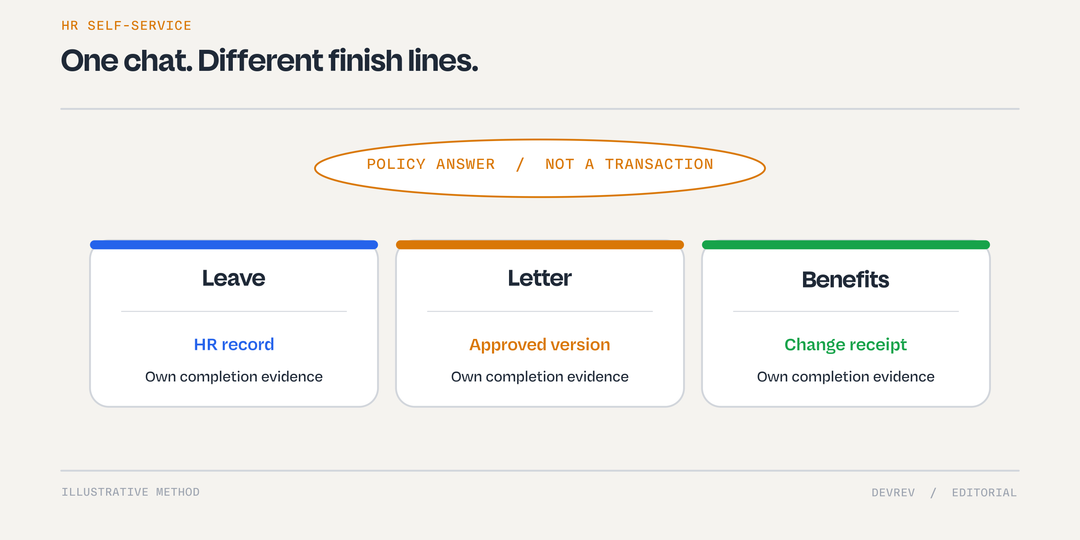
Illustrative HR job map – A policy answer can finish a question; leave, letter, and benefits changes each need separate authorized records and completion evidence.
Three messages produced four jobs, one justified refusal, one verified discrepancy, and four separate pieces of proof. One "resolved" status would have hidden all of it.
Within each column, every state ties to one employee and one request, document, or enrollment, with its own timestamp. Never merge units across columns. A download of last year's letter isn't proof for VL-2209.
When a job stalls or shows the wrong record
A request that never completes should stay visible, with a named owner and a next step. Your HR team sets each job's interval within applicable policy, contractual, and legal requirements. When that interval passes without the completion event, the request routes to a named backup HR owner. Imani should see it as pending, never as done.
Wrong disclosure needs its own path. Salary, medical, or dependent details shown outside permitted fields go to a sensitive-record review owner. OWASP (the Open Worldwide Application Security Project) recommends least privilege for AI applications. It also says authorization belongs in downstream systems, not the model.
Track answered versus completed transactions, and authorized versus unauthorized disclosures.
If you're testing Computer, by DevRev, or any assistant, hold it to this worksheet. Ask which states it can show evidence for in your setup, and which you'd configure yourself.
Name the output, the recipient, and the owner first
Before you switch on AI HR self-service for these jobs, someone has to own one row per HR output. Here's Northbeam's version.
At Northbeam, the hard row was the letter. Your policy may never allow a direct send to a consulate, or it may, with a verified recipient. Either answer works.
A blank cell needs a safe default. If no policy covers a recipient, the send stays blocked and goes to the verification issuer for review. The assistant shouldn't invent a rule to fill the gap.
Write your own version of that table, letter row first. With it in hand, a conversation with DevRev about your HR request mix can test each answer against a named recipient and owner.