
The record for case EX-204, a fictional support case, looks tidy at first. The request came in through the authenticated support channel. Triage labeled it and suggested a help article. A review notice went to the specialist group, and the delivery line says it arrived.
The next line is empty. Nobody accepted the case. Elliot, the customer who asked for an account export, is still waiting, and every system involved can say it did its job.
Elliot and everyone else in this trail are invented too, built to show a method rather than report a deployment. The gap they show is the one a human review queue exists to close. A delivered notice looks like progress, but it transfers no responsibility. What follows works backward from that empty line.
The trail, line by line
Read the record the way you’d read an incident timeline. Note what each line proves, and what it doesn’t.
Five lines have entries. None names an owner. The handoff began when review was requested. Ownership begins only when a person explicitly accepts responsibility, and resolution needs separate evidence that the customer received the permitted result.
That’s the whole job of the queue. A human review queue holds support cases that need human judgment before the next action. It needs an admission rule, permitted context, named acceptance, and a fallback when nobody accepts.
EX-204 had the first two. The rest of this article rebuilds the missing two, then follows the case to a result.
Why EX-204 belonged in the queue
Start with the question every postmortem should ask: did this case need a person at all? EX-204 did. One missing fact, Elliot’s authority over account B, could change the next action, and nothing in the available evidence could establish it.
That reasoning generalizes into admission criteria. Admit a case when your policy requires judgment the evidence can’t support. Candidates include missing authority, conflicting context, a policy exception, a high-impact request, or an unresolved specialist dependency.
Don’t admit every case with an uncertain label. Ask which missing fact could change the next action, and who can establish it. A routine documentation question can continue if your policy permits the answer and its disclosure.
A confident classification isn’t permission either. EX-204’s export label was accurate and still useless for the release decision. Use ticket triage for the classification mechanics. When you choose the broader system, compare customer service automation software against your admission and handoff requirements.
Every admitted case still needs a path. This proposed decision aid is a worksheet, not a universal operating standard.
EX-204 took the middle row. Its trigger was written in terms a reviewer could challenge. “Export authority for account B is unverified” beats “AI uncertainty,” and the record also named the policy version and the blocked action.
If you use a confidence score, check its calibration: whether reported confidence matches correctness on representative cases. Don’t substitute one universal cutoff for action-specific evidence. Give each admission rule a decision owner, plus someone who maintains it when policies or responsibilities change.
The acceptance interval is yours to set. Base it on impact, staffing, and backup coverage, and don’t borrow a vendor’s channel timer as your support commitment.
What the specialist would have opened
A claim is only as good as the context behind it. Transfer the evidence needed for judgment, not everything you retrieved. Authentication establishes identity, authorization establishes permission for the requested action and resource, and retrieval alone doesn’t authorize disclosure.
Before review, the next permitted step had already happened. The AI asked only for the minimum account reference, through the approved channel. It didn’t ask Elliot to attach the export or paste credentials.
Keep exports, credentials, and unrelated account data out of the general queue. Define access separately for the triage actor, reviewer, executor, and customer. A review request doesn’t expand anybody’s permissions.
One question belongs in any evaluation here. Does a reviewer’s input only advise the AI while it keeps the conversation, or does it transfer the whole case? Both can be useful, but only the second is ownership.
Where ownership should have changed hands
EX-204 stalled between two states that many queues treat as one. The general human-in-the-loop AI principle provides oversight. This proposed worksheet makes the receiving responsibility observable, and its state names are illustrative, not product fields.
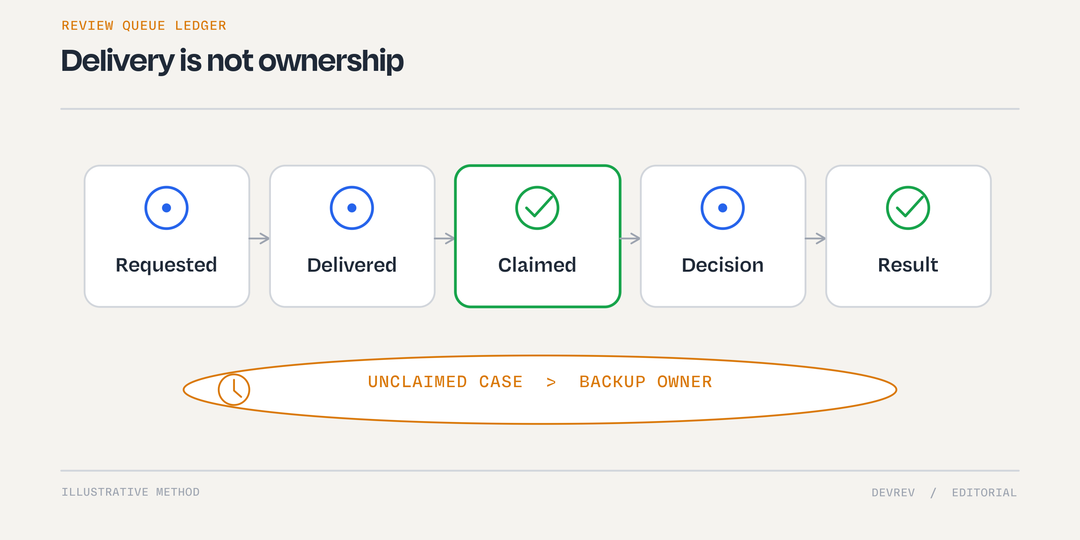
Illustrative queue ledger – A delivered notice is not named acceptance; an unclaimed case needs a backup path.
EX-204 reached delivered and stopped. Define acceptance as an affirmative event tied to the case and the responsible person. An automatically populated owner field isn’t enough. A first human reply shows engagement, but not necessarily acceptance of ongoing responsibility.
Record what the claimant owns: the review decision, the customer follow-through, or both. If someone else executes the action, keep that role separate without dropping the case owner.
Ownership and approval are different, too. The safe actions discussion covers the approval boundary, and claiming a case doesn’t grant authority to disclose an export.
Plan for the transitions that go sideways. A reviewer who lacks the required authority should record the reason and request another owner, and the handoff stays pending until that person accepts. Rejections, reassignments, and reopens all belong in the record. When a reviewer overrides the proposed path, capture the reason and the updated action boundary.
How the case recovered
When EX-204’s interval expired, the case stayed visible and the export stayed blocked. The designated queue steward alerted backup coverage and recorded the missed acceptance. Silence isn’t approval.
Sending the backup notice still didn’t transfer ownership. Maya Chen, the fictional backup specialist, had to claim EX-204 explicitly. If Maya had declined or stayed unavailable, the steward would invoke the next escalation path and record the unresolved status.
Meanwhile, Elliot heard what remained pending and how the next update would arrive. Don’t promise an unavailable specialist or an unverified completion time.
Maya’s claim established ownership. Maya then inspected the authorized permission source, which confirmed Elliot’s current export entitlement for account B. Maya recorded the evidence reference and the permitted decision.
An authorized executor enabled the existing export through the authenticated account flow, without granting new access. The execution path rechecked Elliot’s export permission before allowing access, because an earlier review doesn’t stand in for current authorization. A source-system record confirmed Elliot’s download, and Elliot confirmed receipt of the requested file.
Only those last two records support the successful customer result. Had authority not been established, the right outcome would have been a refusal with the permitted verification path explained. Record a refusal accurately; it isn’t evidence that Elliot received the export.
Timeouts deserve one pointed test before you trust any configuration. When an acceptance interval expires, does the dependent output stay blocked, or can a fallback send the AI’s original draft? Watch it happen rather than reading about it. For a case like EX-204, the disclosure has to stay blocked until authority is established.
Measures that make the next gap visible
The original trail hid its gap because nothing counted the empty line. Agree on case-based denominators before you evaluate the queue.
Measuring only completed reviews would have made EX-204’s first hours invisible. These measures also don’t establish that the queue caused an improvement. Use comparable before-and-after evidence before claiming a benefit.
Hold any tool to the same trail, including Computer, by DevRev. Ask DevRev to show the supported configuration on a safe sample case. Which policy admits it, what stays blocked, and what can each actor see?
Then look for the named claim event, missed-acceptance recovery, and downstream customer-result evidence. Record any step it can’t show as not demonstrated.
Who owns the next quiet case
Accepted ownership is progress, not the finish line. EX-204 needed a claim, a decision, an execution recheck, and Elliot’s own confirmation before anyone could call it done.
Got a real case that went quiet like this one? Trace it from notice to receipt with the DevRev team, and test Computer against your own record. It’ll be messier than a fictional one, which is the point.
The decision EX-204 was missing doesn’t need a demo, though. Before the next shift starts, write down three names.
Who stewards unclaimed cases? Who is first backup when the interval expires? Who decides when the backup can’t take it?
Names alone don’t make anyone accept a case. They do tell you who should claim the next quiet one, and who answers for it when nobody does.