
Two screens recorded the same phone call. The contact center’s queue report logged a clean voice-to-digital deflection: offer played, caller accepted, one fewer person on hold.
The caller’s phone showed a blank chat window.
Noor Haddad, a billing admin at Tidewater Haulage, had called a software vendor named Larkspur about a $120 late fee. Both companies, and every person, record, and amount here, are fictional. After a long hold, the menu texted Noor a chat link that opened empty. Noor retyped everything, gave up, and called back angry.
Both screens were accurate, and that’s the problem. Voice-to-digital deflection moves a caller from the phone queue to chat, SMS, or a portal. It only helps when the request, the verified identity, and the case make the trip too. Here’s Noor’s call replayed the way it should have gone, stopping wherever it can break.
Before the offer: should this call leave the line?
Which calls get an offer is your policy choice, and the guide to customer service automation software shows where deflection sits among your options. For a single call, four checks decide, and any one can stop the switch.
- Suitability. Can the digital channel finish this call reason? A locked-out admin can’t sign in, so no.
- Contact route. Is there a digital contact on file, has the customer agreed to messages, and does local policy allow the channel?
- Identity, then authority. Will the digital session sign in the person on the account, then check what they may see and do on this record?
- Permitted context. Can a case reference and short summary travel without the raw transcript or payment credentials such as card numbers?
The third check is where handoffs cut corners. Recognizing a caller’s number isn’t authentication, because caller ID can be deliberately falsified. Caller recognition says a known number called. Authenticated identity says a specific person on the account signed in.
Authority is a third fact again: that person may view this invoice and request this change. AI agent authorization covers that boundary in depth.
Noor’s call passes. The number matches their contact record, so they’re recognized but not yet verified. The menu captures “billing: fee question” and invoice INV-2207. Fee disputes suit chat, Noor agreed to texts, and local policy allows SMS.
Before the offer plays, these fields should already be set:
If those fields are empty when the offer plays, chat receives a person and nothing else, which is Noor’s first call.
The crossing, one event at a time
This time the menu says: “Press 1 to continue in chat. We’ll text a link to your account mobile, and you’ll sign in before we show any details. Press 2 to stay on the line.”
Noor presses 1. The system opens case CASE-4471, links voice record VC-9031, and issues single-use token H-58Q2. The text carries no account details: “Larkspur Support: continue your request at this link and sign in first. Ref H-58Q2.”
That token is a correlation key. It ties the text to the case, but it isn’t proof of identity or access, because texts get forwarded. So the crossing is a chain of separate events, and each one needs its own evidence.
Notice what never appears in that chain: the phone number. Continuation is proven by BR-12, a binding record written only after sign-in and authorization. A redeemed token or a matching number is a hint, not continuity.
If you also judge calls that finish inside voice, Voice AI resolution separates a voice result from a call that simply left the line.
What arrives on the other side
Once BR-12 exists, the chat opens with: “Thanks, Noor. You’re continuing case CASE-4471 about a $120 late fee on INV-2207. You don’t need to repeat anything.”
That’s the whole difference from the first call. The system knows the case and the amount, and says them only to a session that proved it may hear them.
Priya Raman, a Larkspur billing specialist, sees a context card: “Reports a $120 late fee on INV-2207. Says the $4,800 payment went out on the due date. Identity verified in chat. No card or bank details carried.”
The call recording stays on VC-9031. Only the summary crossed.
If you’re assessing voice agents for a call like Noor’s, Voice AI describes DevRev’s voice offering.
When the link reaches the wrong person
Now suppose Noor forwarded the text, and a colleague without billing access signed in first. The sign-in is real, but authorization fails, so no binding record is written.
The chat says only: “We can’t continue this request from this sign-in. Please contact support through your usual support channel.” It names no account, case, or invoice, and it triggers no callback.
CASE-4471 stays open in the billing queue, which reissues a link to Noor’s permitted mobile. The colleague learns nothing, and Noor’s request isn’t lost.
From a routed case to a $0 balance
Arriving in chat isn’t the same as being helped. The case still has to reach a person who can act, and the result has to show up where Noor can see it.
The billing record shows the $4,800 payment started on September 30, the due date, and posted October 2. Policy BP-3 waives the fee when payment starts by the due date. Priya’s role permits that waiver, so they record the decision before issuing credit.
Priya then writes: “I’ve reversed the $120 fee. Credit memo CM-0193 is on your account, and INV-2207 shows $0. Can you confirm?” Noor replies, “Confirmed, it shows $0.” The $4,920 invoice, less $4,800 paid and $120 credited, is zero.
That reply is what the queue report missed the first time. Three words describe what can happen, and they aren’t interchangeable:
A question resolves with a correct, authorized answer. A change request like Noor’s needs a changed source record and the customer’s confirmation.
The continuity record for every switch
Keep one row like this for each switch. It’s a method proposed here, not an industry standard, and the field names are placeholders for your own systems.
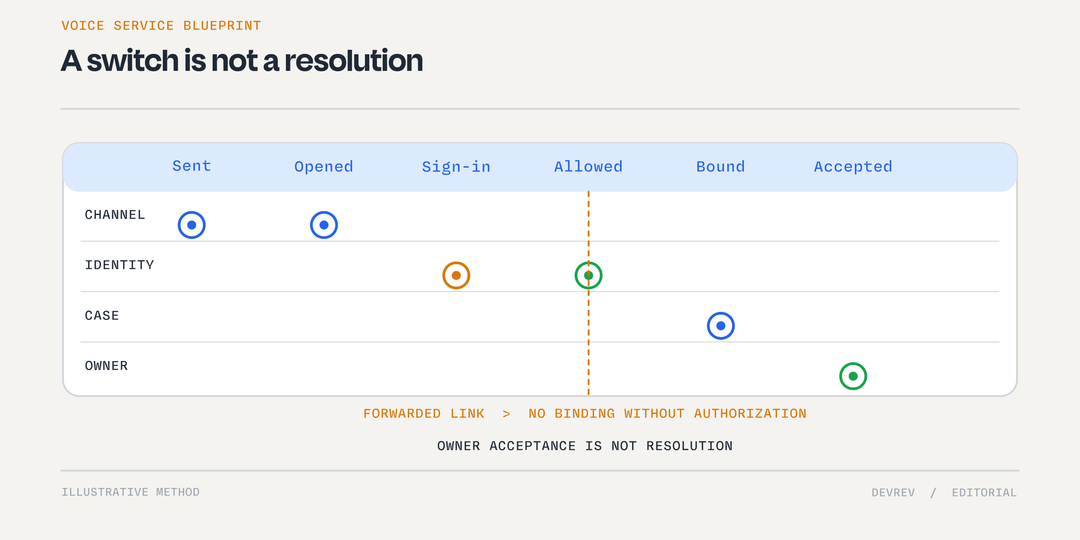
Illustrative service blueprint – Delivery, sign-in, authorization, case binding, and named acceptance require separate evidence; owner acceptance is not resolution.
Owner acceptance gets its own row for a reason. Priya accepting CASE-4471 completed the handoff, not Noor’s request.
When the crossing breaks
An abandoned switch can be worse than a held call, because the caller has already left the line. Design these paths first.
Each path keeps an accountable queue and a next step. A queued case is pending until a named person accepts it, and none of these count as resolved.
Measure your voice-to-digital deflection program the same way. Count offers, sends, sign-ins, bindings, owner acceptances, accepted resolutions, and abandonment on the same cases, defining each denominator first. A deflection count means little without accepted resolutions and abandonment beside it.
If you’re weighing Computer, by DevRev for this handoff, test it against these states. Ask DevRev to confirm which of them a supported configuration covers.
Every exit needs a working route
Go back to Noor’s first call. The chat offer wasn’t the failure. Nobody owned what happened after Noor pressed 1, so the only route left was to dial again and start over.
Walk your own menu script through the states above and ask one thing at each exit. Does the caller still have a way forward that keeps their case? That might be the live line, a link reissued to a permitted contact, a named owner, or a number with a case reference. If you’d like a second reader for that script, you can walk through your voice-to-chat handoff with DevRev.
Any exit that ends in a blank window is where your next caller starts over.